(512) 416-7700 | CONTACT US | MAP

(512) 416-7700 | CONTACT US | MAP

Every culture and class understand healthy behaviors and define health in their own unique ways. There are, however, basic habits all people can adopt to lead a longer and healthier life. Here the focus will be aimed towards the needs and mindset of mature readers, but these suggestions could apply to most as well.
Those in their golden years make certain assumptions and have specific expectations about what a healthy lifestyle means. A recent study done by Social Science and Medicine interviewed 145 male and female rural North Carolina residents aged 70 and older. These interviews revealed seven key factors these participants regarded as important to maintaining a healthy lifestyle. They included: (1) Eating Right, (2) Drinking Water, (3) “Taking” Exercise, (4) Staying Busy, (5) Being with People, (6) Trusting in God and Participating in Church, and (7) Taking Care of Yourself. These domains are multi-dimensional and have overlapping content, but the four major themes are: “balance and moderation”, “the holistic view of health”, “social integration”, and “personal responsibility”(1). Staying healthy into your later years may allow you to be a better member of the community.
One key aspect of staying healthy is consuming the nutrients needed to create and maintain healthy bones, teeth, skin and body(2). This starts with conscious daily decisions to eat right. Key nutrients in the diet allow you to live longer and stay sharper mentally, plus you’ll have the energy to keep up with the younger generation. Some of these nutrients include B vitamins to keep you energized, vitamin D from the sun to help fortify bones, magnesium responsible for over 300 physiological processes and a big player in cellular vitality, fiber for healthy digestion, and omega-3s that support brain and memory(3). We all have different caloric needs based on weight, age and activity level, but the basics of healthy eating apply to everyone. A good place to start would be to consume 50% of your daily food in vegetables, eat fruit, some protein with every meal adding healthy fats to diet like coconut oil and avocados, limiting sugary and processed foods, and drinking lots of clean, filtered water. If these dietary changes seem challenging or difficult to swallow, start with a smoothie of banana, spinach, flaxseed, yogurt and apple juice. Try something palatable and nutritious. When applied in moderation choosing these foods will help you maintain your weight and feel great well into your later years.
Another component to healthy living for seniors is physical activity. To measure the physical needs of the elderly, the European Journal of Cardiovascular Prevention, followed over 2,000 seniors to assess their ability to move from sitting to standing without aid. After 6 years, the study revealed a dramatic connection between physical abilities and longevity. It concluded that “if a middle-aged or older man or woman could sit and rise from the floor using just one hand or even better without the help of a hand they were not only in the higher quartile of musculoskeletal fitness but their survival prognosis is probably better than those unable to do so”(4). This study suggests that simply maintaining the ability to move from seated to standing unassisted greatly improves their chances at living longer. This is best achieved by maintaining fitness throughout one’s life. There is evidence to support that health maintenance in your later years begins by cardiovascular fitness and strength training in your younger years. Your ability to move, walk, stand and pick things up is the key to the fountain of youth. Instead of being sedentary, maintain your fitness through flexibility exercises like yoga, challenge your balance with exercises like qi gong or tai-chi; add in weekly weight training with practical exercises like push-ups, getting up and down from the floor and walking to keep your body and legs strong.
Many seniors may find a structured exercise program intimidating or difficult due to prior injuries or too many sedentary years. Consider getting the help of a chiropractor to help you move better and free up energy to feel your best. A chiropractor is trained to identify specific areas of muscular and structural imbalance and correct those imbalances to keep you moving efficiently and with ease. Gentle adjustments help restore range of motion and decrease pain, improving biomechanics of movement and awareness of the body. Chiropractors also make lifestyle recommendations to track progress in diet, exercise, sleep and mentality. Our gentle approach at Clear Point Wellness is designed to identify where stress and tension reside in the body and remove that interference through gentle pressure and mobilizations to help you feel like yourself again.
The spiritual component of aging is a journey that is both deep and wide. To create health and happiness in your life, do what Deepak Chopra suggests and “take it easy” by pursuing excellence, not success(5). Weaving spirituality through life experiences encourages wisdom and peace. It is our own responsibility to enhance our lives through spirituality. Doing something each day that brings you closer to nature, like deep breathing, meditation, attending church and laughing, all transform our inner life by showing us bounty and beauty and keep our stress levels under control.
Staying healthy as you age goes more than skin deep. Establishing healthy habits like eating right, exercising, and taking care in both personal and social responsibilities ensures graceful aging for a long and happy life(6). The tips above apply to all ages and can begin to be practiced now. If you’d like to learn more about how to integrate the wellness lifestyle into your life, our staff is able to guide you in your journey and help you discover the benefits of healthy habits. What habits do you have that create longevity in your life?
In health,
Dr. Amanda
_______________________________________
(1) http://www.sciencedirect.com/science/article/pii/S0277953600004421
(2) http://www.helpguide.org/life/senior_nutrition.htm
(3) http://www.webmd.com/healthy-aging/nutrition-world-2/missing-nutrients?page=1
(5) http://www.huffingtonpost.com/2013/05/25/deepak-chopras-best-advice_n_3333052.html
Nearly all of us nowadays chronically forget to breathe. Constantly barraged with stress from family, relationships and work, we fail to do our most basic biological function…breathe.
We forget, yet we all know how important breath is for our cardiovascular, digestive, neurological and mental health. What follows are some of my favorite tips for loosening the breath as well as some breathing exercises if you find yourself unable to sleep or going about your daily activities.
Releasing the breath:
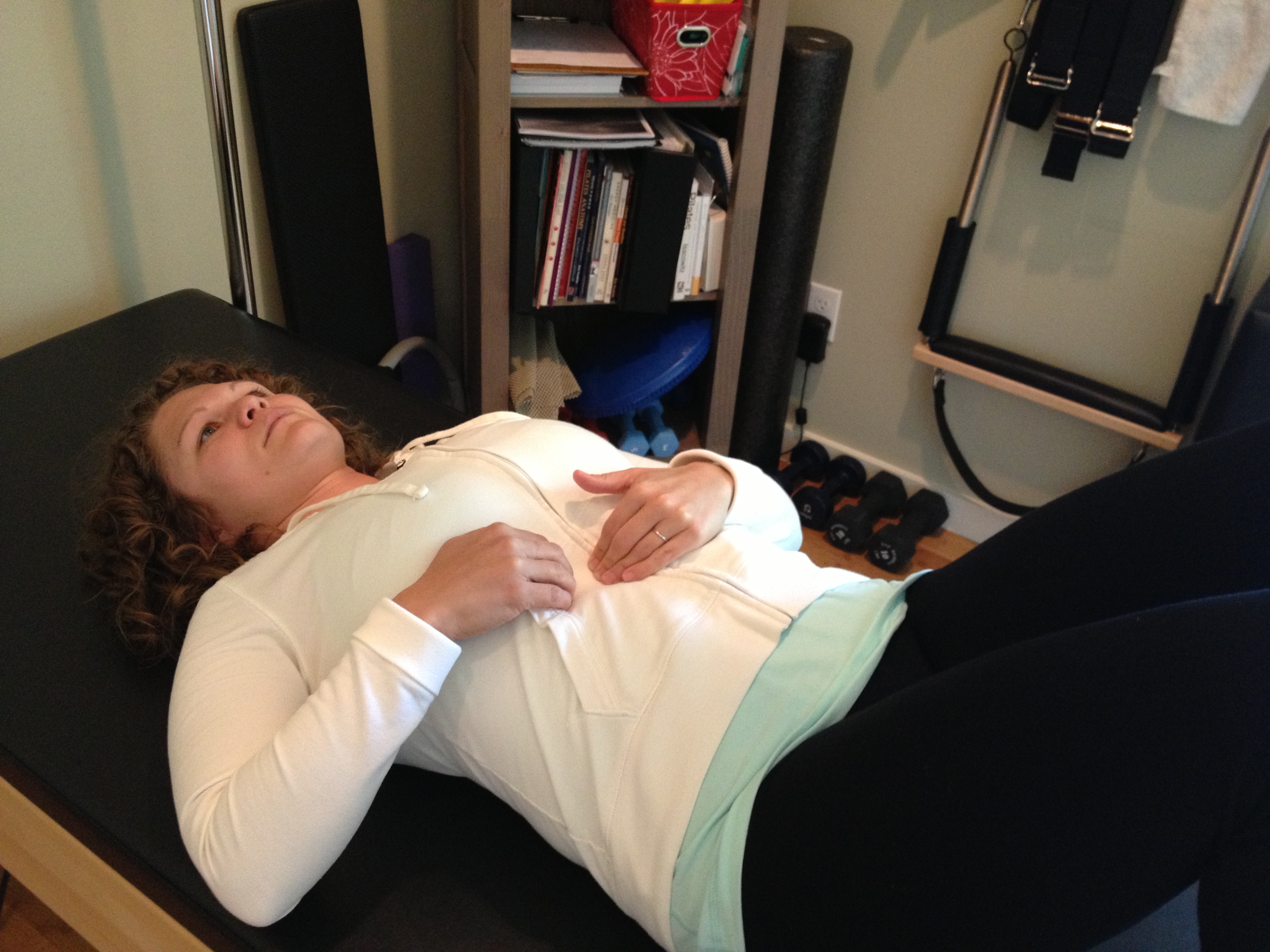
Diaphragm Release
Laying down on your back, place four fingers of one hand underneath your rib cage on the same side near your sternum. You’ll gently lift your rib cage, then take your fingers of the opposite hand and lightly slide the skin away from your ribs. Then, walk the fingers under the rib cage a little bit further down and pull with the other hand again. You’ll do this all the way down until you hit the side of your body. Take a few breaths after releasing the first side and feel how much easier it is to breathe on that side. If you stand in front of a mirror, you will actually see your rib cage expand more on that side of your body versus the side you have yet to release. Essentially you are loosening the surface connective tissues around your rib cage and diaphragm.
Chair position
Another great way to make it easier to breathe while you are seated is to be sure that your hips are slightly higher than your knees. Nearly all chairs and car seats automatically place our bodies in a position where our hips are lower than our knees. This creates a tilt in our pelvis and makes it harder for us to breathe. If you can at least adjust the height setting on your chair and/or put a towel or pillow in the chair to lift your hips, you will find that breath flows more easily.
Remembering to breathe:
Visual object
Sometimes it just helps to have a picture, object, song or poem to remind us to breathe. A friend once gifted me a beautiful, rose quartz stone that I used to keep in my line of sight when I worked a desk job. That serene color and reminder of the outdoors often reminded me to take a moment to check in with my breath. A calming picture as wallpaper on your computer or phone as well as a favorite song (my favorite here) or saying to remind you to smile and breathe can all be helpful cues.
Count breath
This is my favorite technique to give my clients because it can be done anywhere and it is my go-to when I cannot sleep.
Take an inhale and an exhale and notice the quality of each. Is the inhale longer than the exhale? Is it difficult to take a breath in? Do you feel like you have to yawn or sigh to exhale? Begin to count how long it takes you to do each and try to make them equal in duration. You may find that at first observance you have a 3 count inhale and exhale. With each next breath, attempt to add on one count. There is no ultimate goal or number of breaths to take, but notice how your heartbeat inevitably slows as you extend each inhalation and exhalation.
Full body breath
Take and inhale–notice how far the breath travels down your body. Does your chest move? Do your shoulders rise? Does your belly inflate with air? To encourage the breath to fill my whole torso, I think of my body as an empty vessel and the breath filling each crevice starting with my throat, then ribs, back, belly, hips, thighs…all the way down to my feet. When I exhale, I go back up toe to head and visualize the exhale coming from the feet. During this exhale, I will also contract my tummy muscles and relax my jaw to expel the air.
Back breath
Before learning Pilates, I had never heard of the concept of lateral or intercostal breathing. I never realized that we had muscles in between our ribs (intercostals) and never thought about how the ribs span the back as well. Obvious, I know, but just not something I ever considered when consciously breathing. It took me a while to loosen the tension in my mid back and shoulders so that I could expand my ribs and breath there. Laying face down over a fitness or exercise ball, release your weight into the ball and think about absorbing the ball when exhaling and then inhaling into your back. It’s a wonderful breath opener during and at the end of a workday, and it helps to relieve back and shoulder tension.

There are many books and videos out to help us rediscover and remind us to breathe. My favorite is The Breathing Book by Donna Farhi. Not only is it a fantastic pre-bed or weekend read, it also makes a wonderful gift for a loved one. Remember…you’re alive!
Happy breathing.
Shannon Rashap, CPT, M.A. Ed.
Helping you find effort with ease…
Several years ago I began experiencing a sharp pain deep in my left gluteal muscle that was made worse after sitting or even laying down. After many fruitless trips to various doctors and practitioners, I discovered the problem muscle when looking at a poster of the muscles of the human body–the piriformis! As I did some Internet searches, it seemed that I fit the bill of someone who suffers from piriformis pain: desk worker who also likes to run long distances on the weekend. Ever since this ah-ha moment, I have sought out exercises that I can do to relieve this pain and how to prevent future episodes of my piriformis acting up.
The piriformis is a deep deep muscle that connects the low back to your hip. It helps the leg rotate and is a hip stabilizer. When my pain was at its worst, my low back felt locked and going up and down stairs was excruciating. Chiropractic care as well as these exercises helped me to rehabilitate so that I’m now focusing on preventative care.
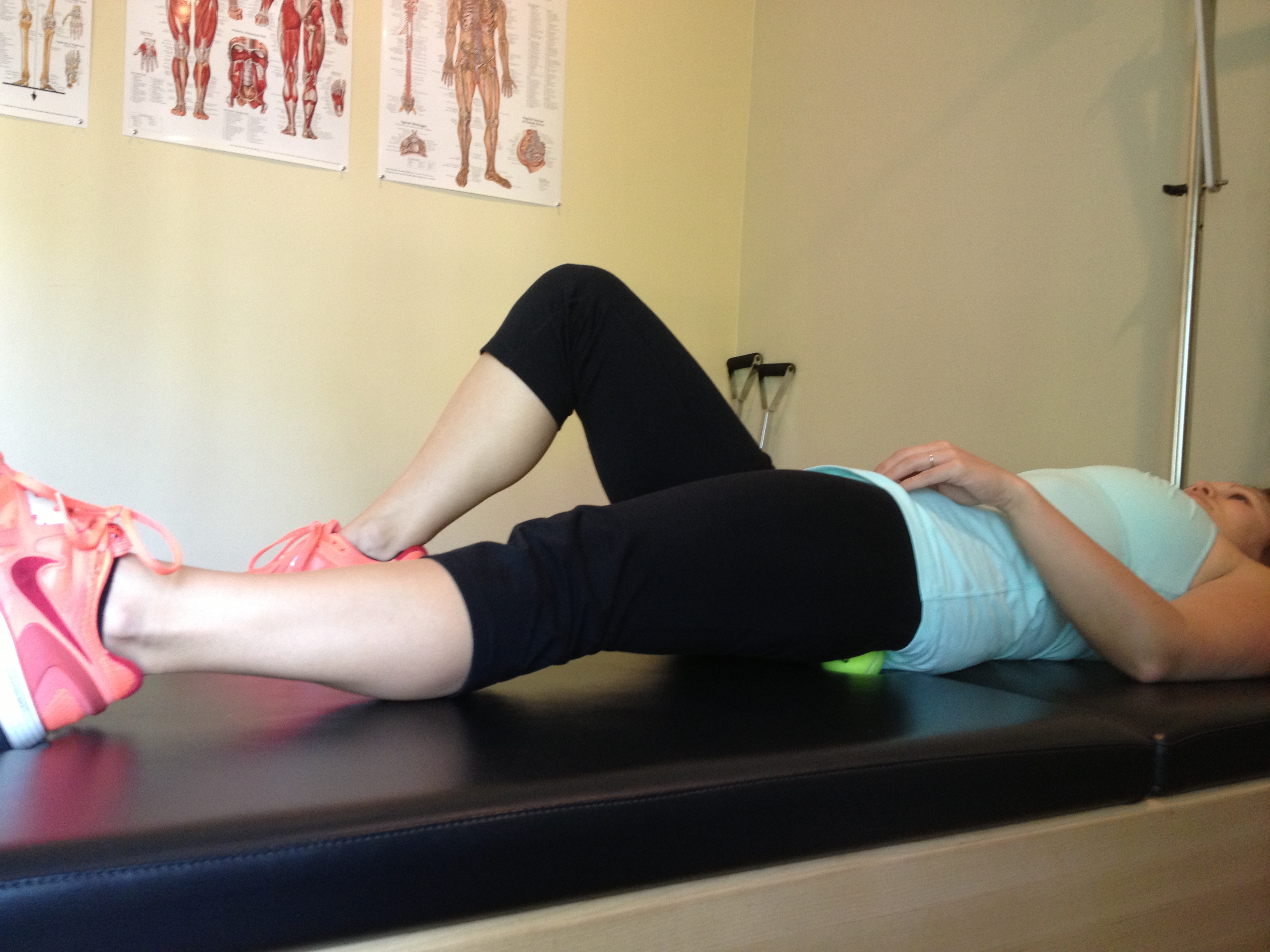
Piriformis pressure point release.
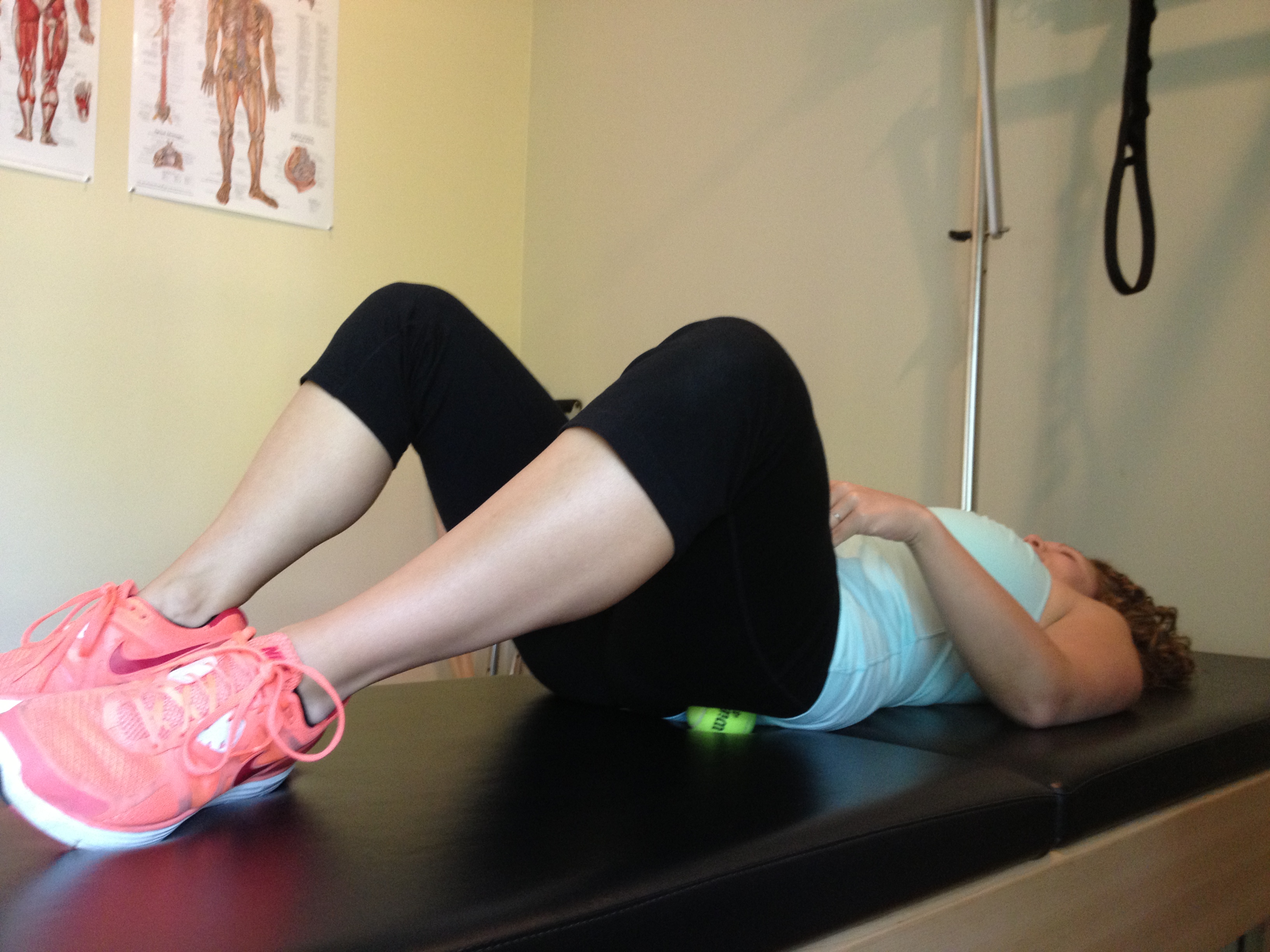
Piriformis muscle release with tennis ball.
A tennis ball of all things became my best friend and helped me release some of the tension in my piriformis. There is a trigger point right in the middle of the butt to release tension in the piriformis. Lay on your back and put the tennis ball in that pressure point. You’ll know you’re on the right muscle if you bend your knee with feet flat and let the knee relax out to the side (making a 4 with your legs). This is a great hip release for anyone who sits for long periods. From there, make circles each direction by sliding your foot straight out with the knee to the ceiling and then open the knee from the hip and slide into your figure 4 position. Take your time and try to release your weight on the tennis ball–don’t fight it.
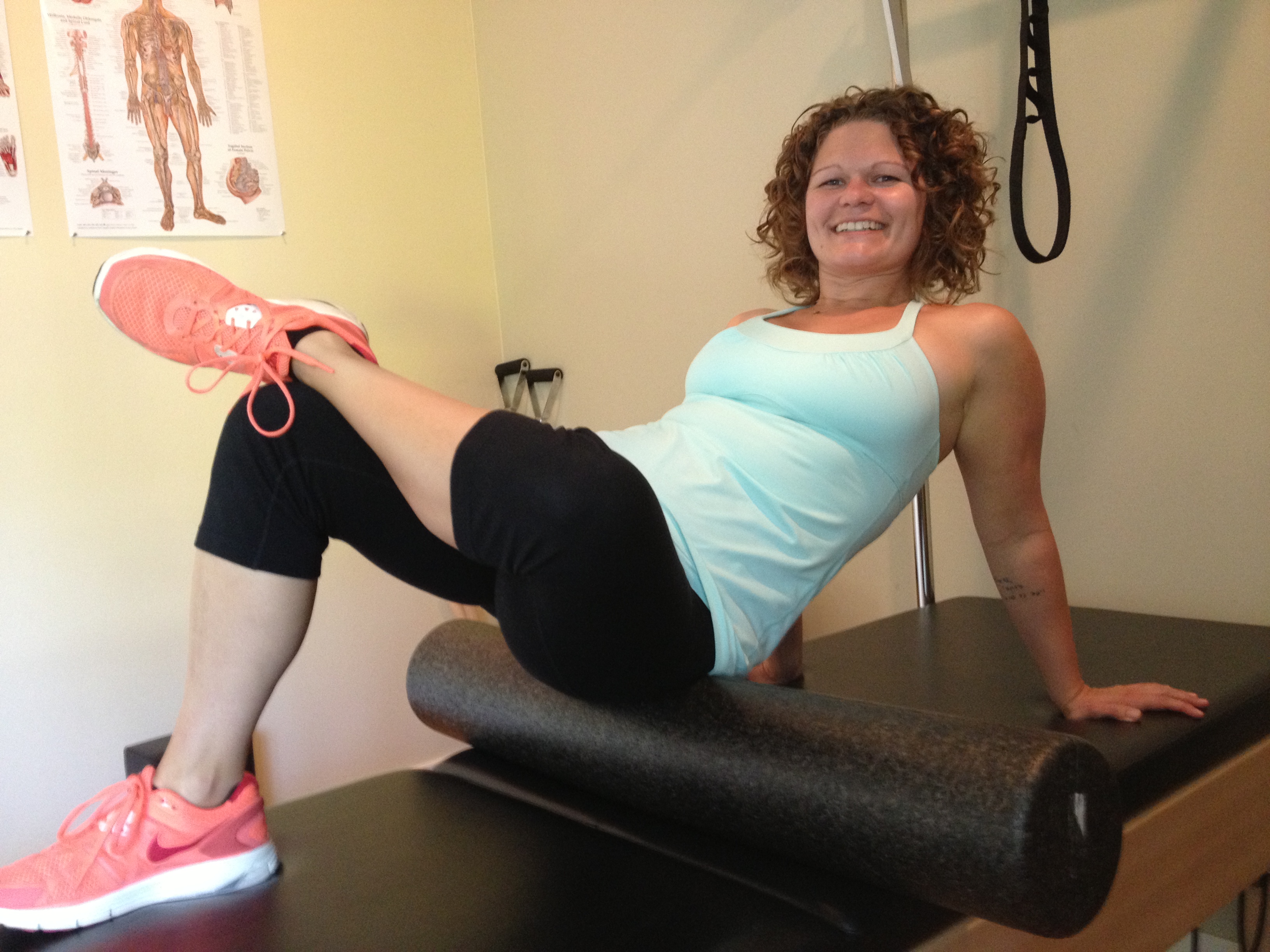
Foam roller fascia in butt.
Using a foam roller on my glutes after the tennis ball release helped to relieve tension in that area as well. Sit on a foam roller and rock your weight onto one cheek, then cross the same ankle over the opposite knee. Roll back and forth.
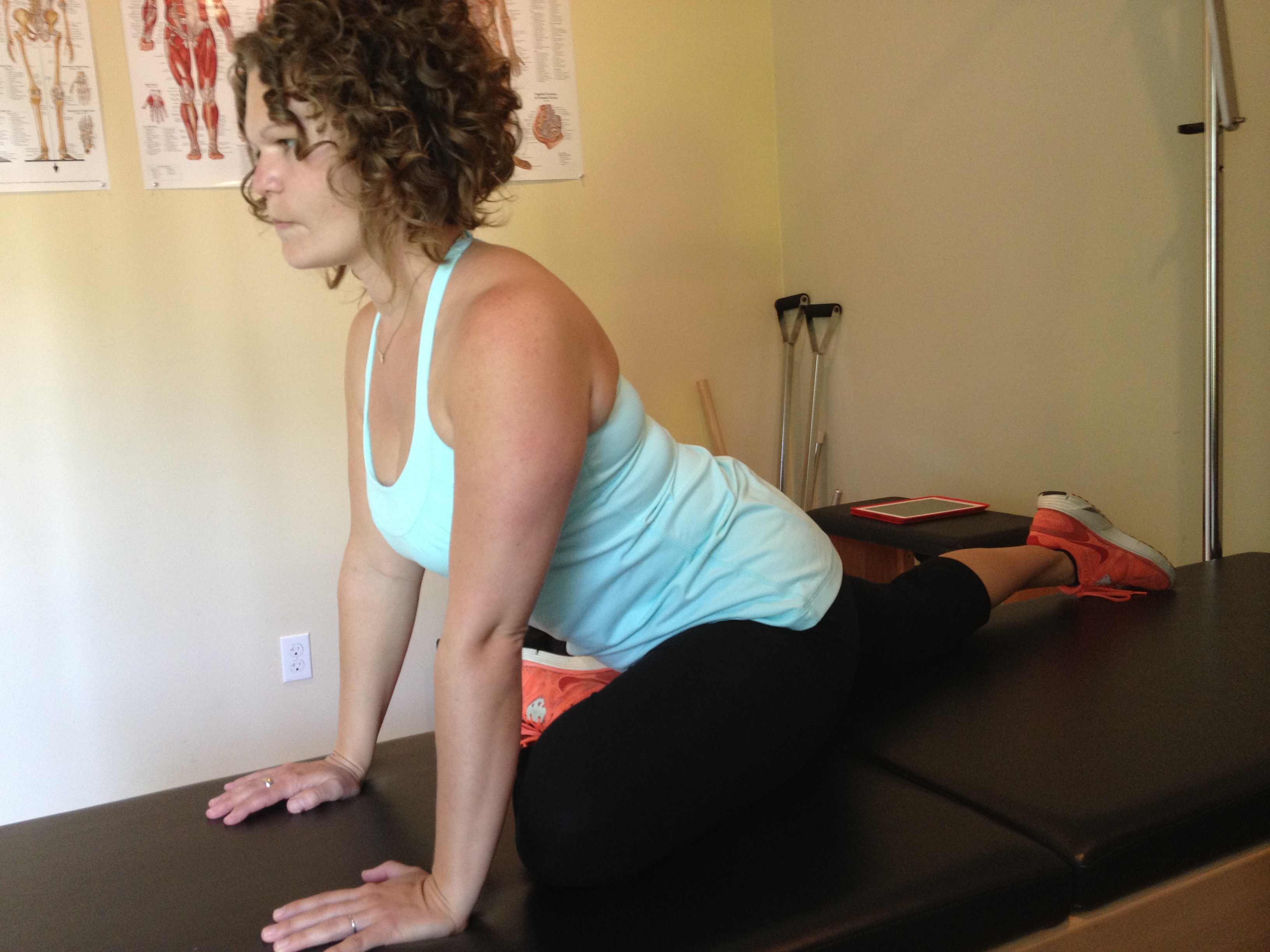
Yoga pigeon pose
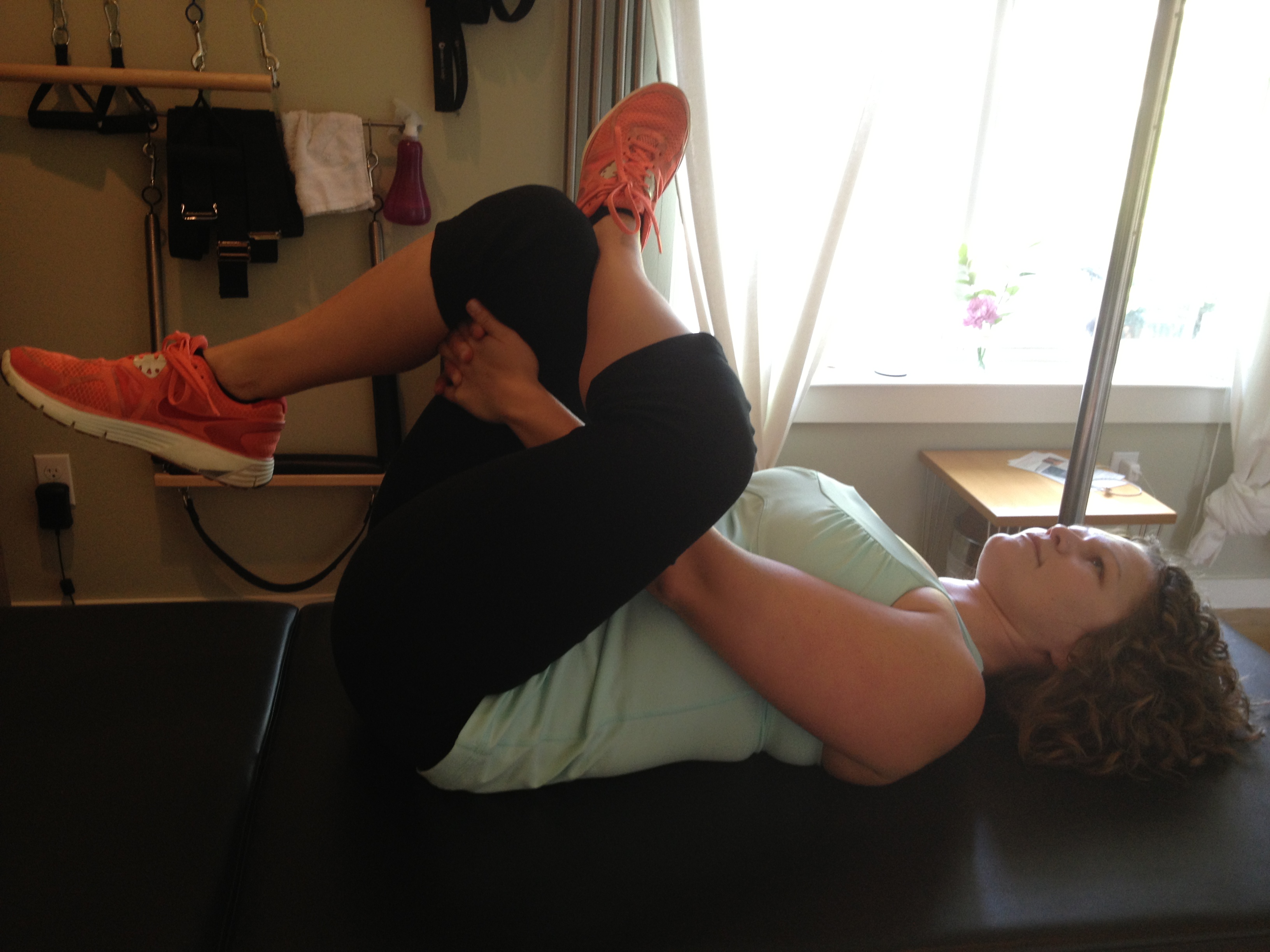
Runner stretch
For stretching, pigeon pose and the runners stretch were the most helpful stretches for at home or in the office.
These are fantastic exercises for anyone who sits for long periods. They help to get blood moving to your bottom that usually interfaces with a chair. When establishing a preventative program for myself, I believe one of the reasons for my initial pain was having weak butt muscles from sitting all day at work and then attempting physically strenuous activities that necessitated a strong backside. Because of chairs nowadays, we sit and our butt muscles atrophy over time, yet they are so important for posture and walking. I have found that strengthening my gluteal muscles, particularly the gluteus medius, has been the best thing for keeping me out of pain long-term. Piriformis flare ups also tend to happen more frequently to those of us who pronate (when the ankle falls in to the midline of the body). Piriformis issues can also play a role in sciatica. If you feel any shooting pain in your back or leg, please see a qualified chiropractor, physician and/or physical therapist for care.
Shannon Rashap, CPT, M.A. Ed.
Helping you find effort with ease…


